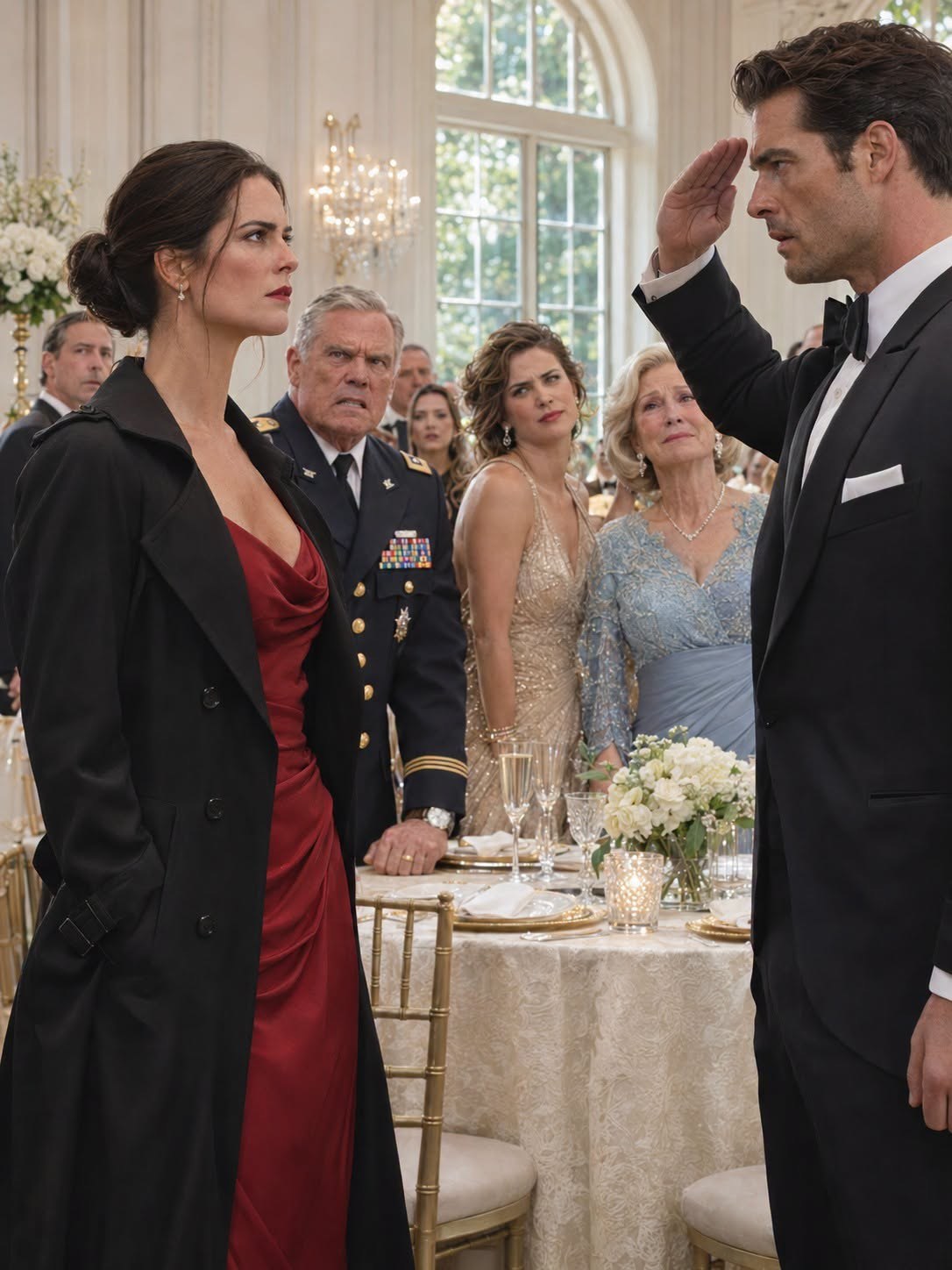
“YOU’RE AN EMBARRASSMENT. DON’T SHOW UP.” MY DAD SAID TO ME BEFORE MOM’S BIRTHDAY. BUT AT THE PARTY, MY SISTER’S BOYFRIEND LOOKED AT ME AND SAID: “MA’AM… COLONEL” THE ROOM FROZE, THEIR MASKS FELL
“you’re an embarrassment. don’t show up.” my dad said to me before mom’s birthday. but at the party, my sister’s boyfriend looked at me and said: “ma’am… colonel” the room froze, their masks fell
I wasn’t invited to my own mother’s birthday. The message came from my sister like a dagger disguised as courtesy.
“Dad says, ‘Don’t come.’ He wants peace.”
Peace? They meant silence. The kind that comes after you’ve been branded a traitor and erased from every family photo.
But I didn’t come to make peace. I came to see the woman who once cried into my coat and whispered, “I know who you really are.”
So I showed up, quiet and alone, in a red dress that didn’t ask permission.
I watched from the shadows until someone stepped out of them. My sister’s boyfriend. He smiled like he knew something.
“Ma’am,” he said, “you really don’t belong here.”
I looked him dead in the eye.
“Neither do you. But only one of us is leaving with the truth.”
Before I share my story, I want to know you’re here with me. Just say “Listening” in the comments or let me know where you are. I love hearing how far my stories reach. Don’t forget to subscribe and join me on this journey, where the unspoken feelings of the past finally find their voice.
Sometimes even the smallest connection can make a story feel heard. Thank you.
And now, here’s my story.
I hadn’t heard from Samantha in months. Not since the last clipped phone call where she’d told me, “Don’t stir things up, Val.”
So when her name lit up in my inbox at 2:14 a.m., I knew it wasn’t going to be warm. Still, a small, foolish part of me hoped maybe this time she’d ask me to come home.
I opened the message. One line.
“Dad says, ‘Don’t come.’ He wants peace.”
Peace. That word had never sat right with me in this family. Peace meant silence. Peace meant obedience. Peace meant disappearing and never asking why.
I stared at the screen, feeling something heavy settle in my chest. Something familiar. Disappointment. Humiliation. A kind of grief that never had time to properly die.
It was my mother’s 65th birthday. She was the only one who ever spoke to me like I still mattered.
The last time I saw her, she had clutched my wrist in the backseat of her Lincoln and whispered, “Please, Val, just go. Don’t make this worse.”
Her eyes were wet, her fingers trembling. But I went. I always went because I thought that was what love was in this family. Leaving so they could breathe.
Eight years ago, my life had combusted in Damascus. A covert CIA operation gone wrong. A team of good men dead, and me left standing in the dust, accused of selling out my own.
I had my clearance revoked. My name was blacklisted. But worse than that, worse than the agency shutting the door, was the silence from home.
My father, General Raymond Monroe, never said my name again.
Before Damascus, I was the golden child. Recruited out of Yale, trained in Langley, the youngest operative ever cleared for Tier One fieldwork in the Middle East. And Raymond had basked in it like it was his own glory.
“My daughter’s saving the country,” he used to say.
Now I was his shame, his ruin. So he banned me from the house, from the birthdays, from the family.
And yet I couldn’t stay away.
Maybe it was foolish. Maybe it was pathetic. But I had to see her, my mother. I had to see for myself if she still looked for me in the crowd like she once did.
I wasn’t going to crash the party. I was going to ghost through it. Slip in, slip out. No mess. Just a glimpse, a goodbye if that’s all I could have.
By morning, I had transformed. Long black trench coat, hair swept into a tight bun, matte red lipstick, and heels that clicked with purpose.
I flew under the name Elizabeth Rowan, booked a suite downtown, and sent a bottle of wine to the Monroe household, signed from a fictional hedge fund.
They were hosting the party in the grand ballroom of the estate. I’d grown up running those halls, but tonight I would be a stranger in them.
And that’s exactly what I became.
I arrived just after dusk. The driveway was packed with black cars and gray suits. The Monroe estate gleamed under the glow of imported lanterns and government-funded pride.
I passed through the gates like any other guest. The security guards checked the list. I gave a name that wasn’t mine, and they waved me through.
Funny how easy it is to be invisible when no one expects you to exist.
Inside, the room pulsed with the hum of power. Military brass, high-ranking senators, defense contractors in navy suits sipping $800 champagne.
The walls were lined with portraits of Monroe men. None of the women.
I stayed near the edge of the room, clinging to the shadows, heart thudding in my ribs.
Then I saw her.
My mother stood near the floral archway, smiling politely as some congressman talked her ear off. Her posture looked fine. Her dress looked lovely.
But her eyes… her eyes were tired in a way I hadn’t seen before.
And suddenly I was ten again, watching her fold napkins for my father’s promotion dinner, trying not to cry when he shouted at the caterer.
I inched closer, weaving through the crowd, not daring to breathe.
Then I saw someone else moving toward me.
He brushed my shoulder, deliberate but casual. Tall, clean-cut, tuxedo, sharp jaw. He turned, met my gaze, and smiled.
“Ma’am,” he said smoothly, his voice low and deliberate. “I don’t think you’re on the guest list.”
I froze. The blood in my veins turned cold. He didn’t blink.
Then, leaning slightly toward me, he murmured, “Damascus still shows in your eyes.”
My mouth went dry.
Who was he?
No one outside the agency ever mentioned Damascus by name. The operation was scrubbed from every official record. My file was sealed tighter than Fort Knox.
Only ghosts knew what happened there.
And yet this man, this stranger, had just resurrected it in a whisper.
My pulse spiked. I stepped back, nearly colliding with a waiter. The man didn’t follow. He simply smiled again and disappeared into the crowd.
I moved fast, slipping into the corridor, heart racing. I needed air. I needed a moment.
Was he agency? Blacklist? An old handler? An enemy?
No. He was something worse.
I caught the name from a nearby conversation.
Ethan. Ethan Clark.
Samantha’s boyfriend.
What the hell was he doing here? How did he know me? And why the hell was someone like him attached to my sister?
I found an empty corner near the west wing, pulled out my burner phone, and texted a contact I hadn’t used in five years.
Need intel on Ethan Clark. Urgent.
No one knew I was here, but someone sure as hell saw me. And that meant whatever I thought I was walking into, it had already seen me coming.
I hadn’t planned to follow Ethan. I hadn’t planned anything, really, other than to drift through the edges of the party and disappear without making a sound.
But something about the way he looked at me, so sure, so surgical, made my instincts scream.
I saw him slip away from the ballroom, weaving through the back hallway like he knew every creaking floorboard.
I followed from a distance, careful not to draw attention. When he turned the corner toward the west wing, I stopped just short of the archway.
He was speaking with someone. Low, clipped tones, a hand extended, a short, firm shake.
Raymond.
My father stood in the shadows, the weight of his posture unmistakable. He didn’t look frail. He never had.
But there was something in his stance, something too calm for a man whose former disgrace of a daughter was floating somewhere in his own house.
They spoke in short bursts, inaudible to me, but the body language said enough.
Familiarity. Agreement. Calculation.
Ethan patted his shoulder once, then walked away like nothing had happened. I held my breath until he disappeared down the opposite corridor.
So they were connected. And not just socially. It felt older, deeper, dirtier.
I turned to retreat, but something stopped me.
The faintest sound. A raised voice, sharp and trembling.
I followed it. The library door was cracked open.
Inside, the light was warm, but the atmosphere wasn’t. I leaned close, careful not to cast a shadow.
“You can’t keep covering for him, Mom.”
Samantha’s voice, brittle and furious.
“You know what he’s doing, what he’s planning, and you still stand there like he’s some kind of hero.”
“Sam, stop,” Lillian said, her voice low, pleading. “You don’t understand how far this goes. If this comes out, it won’t just destroy him. It’ll destroy all of us.”
There was silence, the kind that usually comes before something breaks.
Samantha’s voice cracked.
“Maybe that’s what should happen.”
Then footsteps.
Samantha stormed out the other side of the library. I crouched back into the shadows, avoiding her line of sight.
As she vanished, I peered into the room.
My mother stood alone, one hand gripping the armrest of the wingback chair like it was the only thing keeping her upright. Her shoulders sagged. Her eyes were fixed on the fire but vacant.
She looked trapped, and in that moment, something shifted in me.
I stopped thinking like a daughter and started thinking like an operative again.
I waited until the hallway cleared, then crept upstairs to my father’s study.
It was locked, of course, but old locks had old weaknesses.
Inside, the room smelled like cigars and cold power. His laptop sat on the desk, screen dark. I slid into the leather chair, fingers moving on autopilot.
Password. The same one he’d used for years, some obscure reference to a Korean battlefield.
It worked.
The desktop was a mess of folders, but one stood out. No label, just a string of numbers.
I opened it.
There were emails, encrypted, but I broke the first layer fast. Logistics, meetings, money transfers, and then Helios Arms.
The name made my stomach twist. A notorious defense contractor known for manufacturing weapons that never officially existed.
In one email, a schedule for a covert summit involving foreign investors and off-the-record U.S. military figures.
In another, blueprints for weapons routing through Yemen and Syria, traced through shell companies.
Then came the audio file.
I clicked it.
A voice. His voice.
“Create pressure and the demand will follow. No chaos, no market. We’re not saving the world here. We’re stabilizing the economy.”
My father’s voice. Calm, cold, confident.
I shut the laptop slowly, like the lid might bite me if I moved too fast.
This wasn’t about me anymore. Not just me.
This was about a machine much larger, and my family’s fingerprints were all over it.
My mother knew. Samantha maybe knew more than she let on. And Ethan… Ethan was the bridge between two worlds I was never supposed to connect.
I left the office the same way I came. Silently, like a shadow returning to the wall.
But inside, everything was loud.
Because for the first time since Damascus, I realized something terrifying.
Maybe I wasn’t the traitor.
Maybe I was the loose end they couldn’t tie up.
I waited until the sky turned that strange gray-blue before dawn. The kind of sky where everything feels like it might break.
Then I texted Samantha.
Meet me in the garden. No one else. Ten minutes.
I didn’t know if she’d come, but she did.
She looked older in the morning light. Not tired, just worn down in a way people get when they’ve been keeping too many secrets for too long.
She walked toward me without speaking. Her arms were crossed tight across her chest.
I went straight to the point.
“Who is Ethan, really?”
Her jaw tightened.
“I told you, he’s—”
“Don’t. Don’t lie. Not now.”
She looked away, biting her lip. Then her voice cracked.
“I don’t know everything,” she said. “But I know he’s not who he says he is. I know he’s not just some hedge fund manager.”
“Then why is he here?”
“Because I let him be.”
I blinked.
“I thought I could handle it,” she continued. “I thought if I stayed close, maybe I could protect Mom. Maybe I could control what he saw. But it’s too late. He knows too much.”
I took a step closer.
“Why didn’t you tell me?”
Samantha’s eyes filled.
“Because it wouldn’t have changed anything.”
Twist the knife.
I swallowed hard.
“You let me think she abandoned me. That she didn’t try to reach out after Damascus.”
Samantha froze.
I pressed on.
“You knew, didn’t you?”
She looked down.
“Mom wrote you. She called. She even tried to visit, but Dad… Dad intercepted everything. She didn’t even know you’d moved.”
My knees nearly gave.
I had imagined a hundred scenarios. None of them included her fighting for me behind closed doors.
“She thought I gave up on her,” I whispered.
“She cried every night for months, Val, but she couldn’t get past him. None of us could.”
I couldn’t speak.
The pain was too old, too deep. But there was something else now. Something bitter and rising.
“You knew,” I said. “You knew. And you said nothing.”
“I was trying to keep us all from falling apart.”
“You chose silence.”
“You chose vanishing,” she snapped. “You disappeared and left us here with him. Don’t pretend like you were the only one bleeding.”
We stared at each other. Two broken mirrors reflecting different kinds of wreckage.
There was no resolution in that garden. No forgiveness. Just two women who used to be sisters, now bound only by pain.
But before she left, I asked one more question.
“What does Ethan have on you?”
She didn’t answer.
But the way her face fell, the way her eyes darted away, was answer enough.
Whatever it was, Ethan had a grip on her, and I was running out of time to pry it loose.
I wasn’t just guessing anymore. I knew Ethan wasn’t who he claimed to be.
But to understand how far the deception went, I needed proof.
Real proof.
So I went back to what I knew. Surveillance, pattern analysis, digital footprints.
Every estate like the Monroe residence had internal security, and every security system had logs.
That night, while the rest of the guests drank bourbon and toasted fake loyalties, I slipped into the staff office near the kitchen.
The terminal was clunky but accessible. I bypassed the firewall and pulled the guest access logs for the past month.
Ethan’s name showed up a dozen times, most of them not on official event days.
Then I saw it.
Timestamped entries tied to Raymond’s private study. Late hours, discreet entrances, sometimes without even Samantha present.
I cross-checked the data with the parking records.
One license plate popped up multiple times, registered under a corporate shell in Langley. But I recognized it.
That car had once been assigned to Langley’s logistics division.
Something snapped into place.
I dug deeper, accessed a back door into the agency’s dormant personnel archives. It took me hours, but eventually I found what I wasn’t supposed to.
Name: Mark Ethridge.
Status: Inactive.
Clearance: Level Five.
Assignment history: Tactical coordination, Syria, Jordan, and Damascus.
Ethan Clark wasn’t a hedge fund manager.
He was a former CIA field operative.
And not just any operative.
He’d been on my team in Damascus.
I sat back, my hands shaking.
It all came flooding back. His silence the night of the breach, the way he vanished minutes before the explosion, the calm detachment in his eyes when we regrouped under fire.
I hadn’t seen him since that day.
He was the one who’d reported incorrect coordinates for our extraction point. Three good men died because of it, and I was left behind to clean up the fallout alone.
Now he was here with Samantha, aligned with my father.
He hadn’t just recognized me at the party.
He had been expecting me.
I found him later that night in the wine cellar, leaning against the stone wall with a glass of something expensive in hand.
Like this was his house, not mine.
He looked up and smiled when I entered.
“Valerie.”
“You don’t get to use my name.”
He raised an eyebrow.
“You’ve gotten better at staying alive.”
I walked toward him slowly.
“You’ve gotten better at hiding, Mark.”
He exhaled, almost amused.
“So you found me.”
I held up a flash drive.
“I have your files and the audio.”
He didn’t flinch.
“And what exactly do you think you’re going to do with it?”
“Whatever it takes to burn this house of cards to the ground.”
He stepped closer.
“You think your father doesn’t already know I’m here? That he didn’t put me in place?”
My stomach dropped.
“He sent you to Damascus?”
Ethan smiled. It wasn’t friendly.
“You were getting too close to something he couldn’t afford you to find. He gave the order. I made sure it happened.”
I felt the floor tilt.
“He tried to have me killed?”
“It wasn’t personal,” Ethan said flatly. “He just needed you out of the way.”
I couldn’t speak. I couldn’t move.
For eight years, I had been trying to earn back a reputation that he had destroyed. I had begged for redemption while my father shook hands with the man who orchestrated my disgrace.
Ethan finished his drink and set the glass down.
“Leave D.C. tonight. I won’t warn you twice.”
I didn’t blink.
“If you wanted me dead, I’d be dead already.”
“Not my call anymore.”
I turned to leave. At the door, I paused and looked back.
“You’re not the threat I’m afraid of anymore.”
Back in my guest room, I pulled off the wig and heels, scrubbed off the makeup, and looked at my own reflection like it belonged to someone else.
I wasn’t undercover anymore.
I was awake, and I wasn’t going to run this time.
The next morning, the light broke through the greenhouse windows in long golden shards.
I found my mother standing among her orchids, hands gently pruning a half-bloomed cymbidium.
I stepped inside without speaking. She didn’t turn to face me.
“I saw the files,” she said softly. “Last night, on the drive you left.”
Her voice trembled, but she didn’t cry.
“I’ve known for years. Every meeting, every payment, every time he disappeared without explanation.”
I swallowed the lump in my throat.
“Why didn’t you tell anyone?”
“Because I knew what he’d do if I did.”
She looked up then. Her eyes were glassy but fierce.
“I heard him one night on the phone with someone named Quill. He said, ‘She’s getting too close. Clean it up before she ruins the Helios deal.'”
I stood there, rooted to the floor.
“You knew they were going to kill me?” I asked, my voice barely audible.
She took a long breath.
“I knew if I made noise, it would happen faster. I thought if I stayed quiet, maybe they’d let you live. Even if it meant you thought I didn’t care.”
Tears burned in the corners of my eyes.
“You let me believe you turned your back.”
“I never did,” she whispered.
Then she crossed the room and knelt down by a tile. With delicate fingers, she pried it loose.
Beneath it was a small metal box.
She opened it slowly, like unwrapping an old wound. Inside were cassette tapes, USB drives, and a weathered leather notebook filled with tight, careful handwriting.
“I’ve been collecting everything I could for years,” she said. “I didn’t have the reach to stop him, but I knew one day you might.”
I took the box in both hands.
It was heavier than it looked, heavy with truth.
Then she reached out, her hand on mine.
“Ethan’s not just here to blackmail your father. He’s here to erase everything and everyone who knows too much.”
I stiffened.
“Have you told Samantha?”
She hesitated.
“She knows part of it, but she’s blinded. And there’s something else.”
“What?”
My mother looked at me. Really looked at me.
For the first time in years, I saw her not as the fragile woman in the shadows, but as someone who had survived in silence.
“Samantha’s pregnant,” she said quietly. “And the father is Ethan.”
My world tilted again.
Everything had just gotten more complicated, more dangerous, more personal.
And this time, I wasn’t walking away.
The second dinner was smaller, quieter, but somehow more dangerous than the birthday gala.
It wasn’t meant for family. It was for allies, or as my father preferred to call them, strategic visionaries. Defense contractors, retired generals, former policymakers now on private boards, men who shaped wars with pens and profit margins.
The guest list was curated, private. I shouldn’t have been anywhere near it.
But I wasn’t Valerie Monroe tonight.
I was just a sharp-faced event coordinator in a black blazer, clipboard in hand, radio in my ear, and forged credentials in my bag.
A favor owed from a banquet server I’d saved in Kabul had placed me in the caterer’s van without question.
My goal was simple. Get close enough to the main room to plant two discreet recording devices and one camera inside the centerpiece floral arrangement. An ivory ceramic vase filled with blood-red roses.
Everything else was noise.
The house was locked down tighter than usual. Armed guards lingered by the staircase. Even the staff looked like they’d been briefed to be suspicious.
But familiarity had its flaws.
My face had changed. My energy hadn’t.
I walked fast, stayed calm, kept my gaze downward.
Nobody asked questions until she stopped me.
Samantha.
She emerged from the hallway near the smoking room, arms folded, belly just beginning to show under her cashmere sweater. Her eyes were bloodshot, her tone clipped.
“Nice costume.”
I held the clipboard closer.
“You shouldn’t be here,” I said quietly. “Not like this. Not now.”
She ignored it.
“You think sneaking around makes you smarter than him? You don’t know how far he’s prepared to go.”
“I know enough.”
“I know what you’re planning. I know what you planted. It won’t change anything.”
I studied her, choosing my next words carefully.
“Do you know who you’re carrying?”
Her face flickered, just for a moment.
“Of course I do,” she said, her voice trembling but firm. “And at least Ethan didn’t abandon me the moment things got ugly. Can you say the same about yourself?”
That cut sharper than I expected.
“Samantha.” I stepped closer. “You think he’ll protect you? He’s using you just like Dad used us. You’re not special to him. You’re strategic.”
“I’m not your problem to save.”
“No,” I said softly. “But that child deserves better than to be born into a war for someone else’s empire.”
She didn’t reply.
She turned and walked away.
I let her. Somewhere deep down, I knew I had already lost her, but the fight wasn’t over.
Not yet.
I entered the main dining room through the east corridor and slipped the microphone into the base of the rose vase just before Raymond stood at the head of the table.
His voice still carried like a general commanding troops.
“Gentlemen,” he began, “tonight is not about contracts. It’s about trust, about vision, about restoring strength to a world that’s grown far too weak.”
He didn’t know he was being recorded.
I slipped out, moving through the corridor just fast enough to get clear before the broadcast started.
And that’s when he grabbed me.
Ethan.
He came out of nowhere, gripping my wrist hard enough to bruise. He pushed me into the wall.
“Thought you were clever, didn’t you?”
“I’ve been called worse.”
“I warned you.”
“And I ignored you.”
His eyes were darker tonight, less polished, more wolf than snake.
“I’ve got the Damascus audio,” I said quietly. “And the security footage. I know you left that post five minutes before the blast.”
He leaned in, breath hot against my cheek.
“You think this is about Syria? You’re still looking at the wrong war. I’m not following orders anymore, Val. I’m choosing who lives.”
I didn’t flinch.
“You won’t get the chance.”
He didn’t press further, but he didn’t retreat either. His hand lingered on my wrist just a second longer than necessary before he disappeared into the dark.
I checked my phone.
The files were uploading to a secure CIA relay. A backup satellite transfer would go live in less than 24 hours.
Before I left the estate, I sent one final message through a scrambled channel, direct to the only person left inside Langley who might still believe me.
I wrote, “It’s happening tomorrow. I need extraction on standby. And if you hear nothing by midnight, release the whole damn thing.”
Because tomorrow night, it was going public.
All of it.
The gala was held in the Monroe estate’s grand ballroom, refitted with military precision.
Massive banners bore the logos of joint defense ventures. Glass cases displayed prototypes of unmanned combat drones.
The press was barred, but the presence of off-duty federal agents made clear this wasn’t just a party.
It was a coronation.
Raymond’s final ascent.
I stood behind the AV control curtain, wearing the same black uniform, a comms headset pressed to my ear.
I could see him onstage from the side angle, the curve of his back upright and assured.
Lillian was seated near the front, pale, hands clasped in her lap.
Everything was in place.
At 8:42 p.m., he took the microphone.
“My friends,” he began, “we stand at the edge of a new frontier where security is not just strategy but stability. What we build together will define the next century.”
I activated the trigger.
Over the loudspeakers came the sound of another voice.
His voice, on a crackly, timestamped audio file.
“If she gets too close, neutralize her. I don’t care if it’s permanent. This deal with Helios moves with or without her breathing.”
The room went still.
Utterly silent.
People turned in their seats. A few got up and walked out. One man, a defense contractor, tossed his drink and stormed out without a word.
Raymond froze.
For a second, I thought he might deny it.
Instead, he exploded.
He pointed toward the booth.
“She’s here! That witch, my daughter! I should have finished the job in Damascus!”
That was it.
I stepped out onto the stage slowly.
“I’m here,” I said. “And I survived. Not because of you, but in spite of you. And I won’t let you take anything else from this family.”
He lunged forward, but security held him back.
The crowd was now in a frenzy. Phones recording, whispers spreading like fire.
And then chaos.
Ethan emerged from the crowd, weapon in hand, his eyes locked on Raymond.
Not me.
He raised the gun, but before he could fire, I stepped in front of my father.
The bullet tore through my shoulder.
I collapsed to the floor.
Everything was screaming. My body, the crowd, my mother.
Lillian rushed toward me, screaming my name.
For the first time, the world tilted around me, not because of betrayal, but because of love that had been buried too long.
Raymond stared down at me, horrified.
Not by my wound, but by what it meant.
That I had protected him. That I was still human.
That he was not.
And then Lillian stood up, her voice trembling but firm.
“Raymond Monroe has betrayed his country, his oath, and his family. I have the files. I have the recordings, and I will not stay silent another minute.”
She turned toward the room and handed everything to the federal officer standing in the corner.
My vision blurred. I felt cold.
But before darkness took me, I heard her whisper in my ear.
“You are the best thing I ever made.”
And then the lights went out.
But this time, I knew I would wake up on the right side of history.
I woke to the beeping of machines and the low murmur of guarded voices beyond the door.
Sterile white walls surrounded me, and my right arm was bound tightly in bandages. The sting in my shoulder told me I was alive, but barely.
A man in a black suit with a wire in his ear stood at the foot of my hospital bed.
CIA detail.
They were here not for protection, but containment, until the higher-ups decided if I was a hero or another classified embarrassment.
But he wasn’t the first face I saw.
Samantha was.
She sat by the window, hair a mess, eyes red, her hands fidgeting with the hem of her coat.
When I stirred, she looked up, startled, like she hadn’t expected me to wake up at all.
“I didn’t know he’d do it,” she whispered. “I swear, Val, I didn’t think Ethan would actually shoot.”
I didn’t say anything.
Not because I didn’t believe her, but because it didn’t matter anymore.
The moment for explanations had passed. We were on the other side of the explosion now, where the damage was already done.
Outside the hospital, the world had caught up with the truth.
Within 12 hours of the gala, news had spread like wildfire. Every major network ran it.
General Raymond Monroe implicated in international arms scheme.
CIA sources confirm plot to silence internal whistleblower.
Monroe daughter shot during failed cover-up attempt.
The materials my mother and I had compiled, recordings, email chains, off-the-books accounting, all of it had been handed over to Congress and to an internal review board at the Pentagon.
And unlike eight years ago, this time the files weren’t going to disappear.
Raymond had been detained.
Ethan had been arrested on the spot by military police.
He hadn’t spoken a word since. Not to agents, not to the press, not even to Samantha.
Lillian came to see me two days later.
No entourage, no guards. Just a mother, gray-haired and quiet, carrying a small wooden box.
She sat at the edge of my bed and placed the box on my lap with both hands.
“For eight years,” she said, “I wrote to you every month, sometimes every week. Your father intercepted them all. He said you were gone, that you didn’t want contact. I knew it wasn’t true, so I kept writing anyway.”
I opened the lid.
Inside were dozens of envelopes, some still sealed, others crinkled and yellowing at the edges. Each one marked with a date in her delicate handwriting.
Some were blotched with dried ink or tears. They smelled faintly of lavender and age.
She reached inside and picked out one from the very top, one with a tear already halfway across the flap.
“This was the first one,” she said softly. “I wrote it the night I saw your name on the news after Damascus.”
I opened it slowly.
Valerie, my love,
I don’t believe it. Not for a second. I know your heart. I know your honor. Whatever they say, whatever they do, I will wait for you because I know you are the light this family forgot how to see.
My throat closed. My hands trembled.
For so long, I had thought her silence was the echo of betrayal.
But now I saw it had always been love, locked in a box she hadn’t dared show the world.
I held the box to my chest as if cradling a second heartbeat.
Behind her, Samantha stepped quietly into the room.
Her eyes found mine, and for once, there was no resentment, no guilt, just something tender.
“I’ll handle the rest,” she said. “I owe you that. I owe my baby that.”
I didn’t answer, but I nodded.
And in that quiet, something that had once been jagged between us began to smooth.
Not forgiveness, but maybe the start of it.
Three months later, I stood barefoot on a cliff in Maine, watching waves crash against jagged stone.
The CIA had cleared my name officially, formally, publicly.
They’d even offered me reinstatement, another chance to go back into the field, to reclaim the identity that had been taken from me.
I said no.
Some wars don’t end. And some you just walk away from when you finally have the chance.
Instead, I bought a small house on the coast. Nothing fancy, just walls, windows, and peace.
I planted lavender along the edge of the porch, set up a desk facing the ocean, and began to write.
Not about who betrayed me, but about who I became.
About what it means to be the child they try to forget and the woman they couldn’t erase.
My mother visited every Sunday. She brought fresh orchids from her greenhouse.
We’d sit for hours reading her letters together, sometimes in silence, sometimes in tears.
With each one, a piece of my memory softened. What once had been scar tissue became something gentler, something alive.
One afternoon, while we were organizing the old letters, she pulled a small photograph from her purse.
It was me, 12 years old, dressed in a tailored junior cadet uniform my father had made custom, standing tall next to him, his hand on my shoulder.
Both of us smiling for the camera.
On the back, in her handwriting:
That day he was so proud of you. But you’ve gone farther than even he ever dreamed.
I kept that photo tucked between the pages of my manuscript.
Samantha sent me a picture, too. An ultrasound printout with a tiny smudge of a future inside it.
She joined a witness protection program with CIA assistance.
Her message was short.
I’m keeping my child safe. I’m not letting history repeat.
She didn’t need to say more.
And me?
Each morning, I carried the old box of letters down to the sand and sat with it while the sun rose.
Not because I needed to read them again, but because I needed to remember what it meant to be remembered.
No one called me “ma’am” anymore.
No one snapped to attention when I walked into a room.
No one whispered about Damascus.
And I was fine with that because I didn’t need the rank or the mission or the clearance anymore.
I had something better.
I had survived the fire. I had found the truth.
And at last, I had come home.
Sometimes the hardest journey isn’t across battlefields or borders. It’s the quiet return to the place we once called home.
Healing doesn’t always roar.
Sometimes it arrives in silence, in truth finally spoken, in the choice to forgive without forgetting.
If this story stirred something in you, I’d love to hear your thoughts in the comments.
Don’t forget to subscribe and follow the channel for more stories where pain finds purpose and voices once silenced rise again.
View more
Thank you for listening.


0 commentaires:
Enregistrer un commentaire